

Sovereign S3 on your own storage
ObjectGateway gives your applications S3.On storage that you own.In the data center that you choose.
Developed in Switzerland
- API for your applications
- S3-compatible
- The storage you already run
- POSIX filesystems
- Memory at 1,000 requests per second
- ~100 MiB
- With every release
- SBOM + CBOM
Built around what you already have
Keep your storage
ObjectGateway adds S3 to the POSIX filesystems that you already run.
- Local disks, NAS, and HPC filesystems
- No new storage platform
- Backups and capacity planning stay the same
In your control
Your data, keys, and identities stay under your control.
- Runs in your own data center
- Your own keys and identity provider
- Open standards and a clear exit path
Operationally simple
One binary, three settings, and the tools that your operations team already uses.
- systemd package, Compose, or Helm on Kubernetes
- Health checks, Prometheus, and a Grafana dashboard
- OpenTelemetry export and access logs
Cut the cost of S3
In the cloud, you pay for every download and every request.ObjectGateway runs on a small server next to your storage.Your traffic stays on your network.
- Transfer fees per month
- CHF 0
- Request fees per month
- CHF 0
- Storage fees per month
- CHF 0
Example month: 10 TB stored, 5 TB downloaded, 2 million write and 8 million read requests, at the AWS list prices for S3 Standard in the Zurich region on 12 October 2026, converted at the ECB reference rate of USD 1 = CHF 0.83. ObjectGateway charges no fees per gigabyte or per request. Your own hardware and software are not included.
Parallax
Save even more
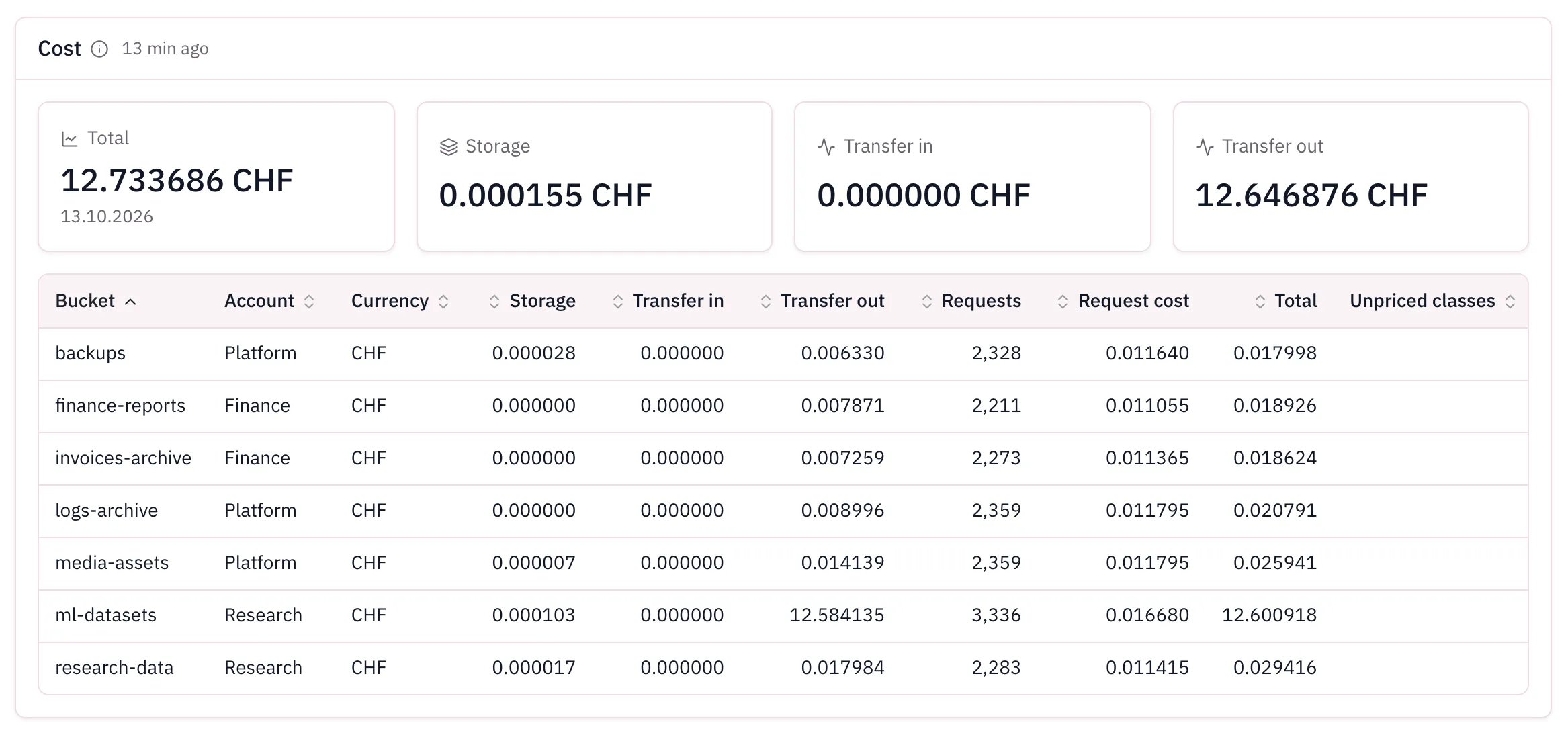
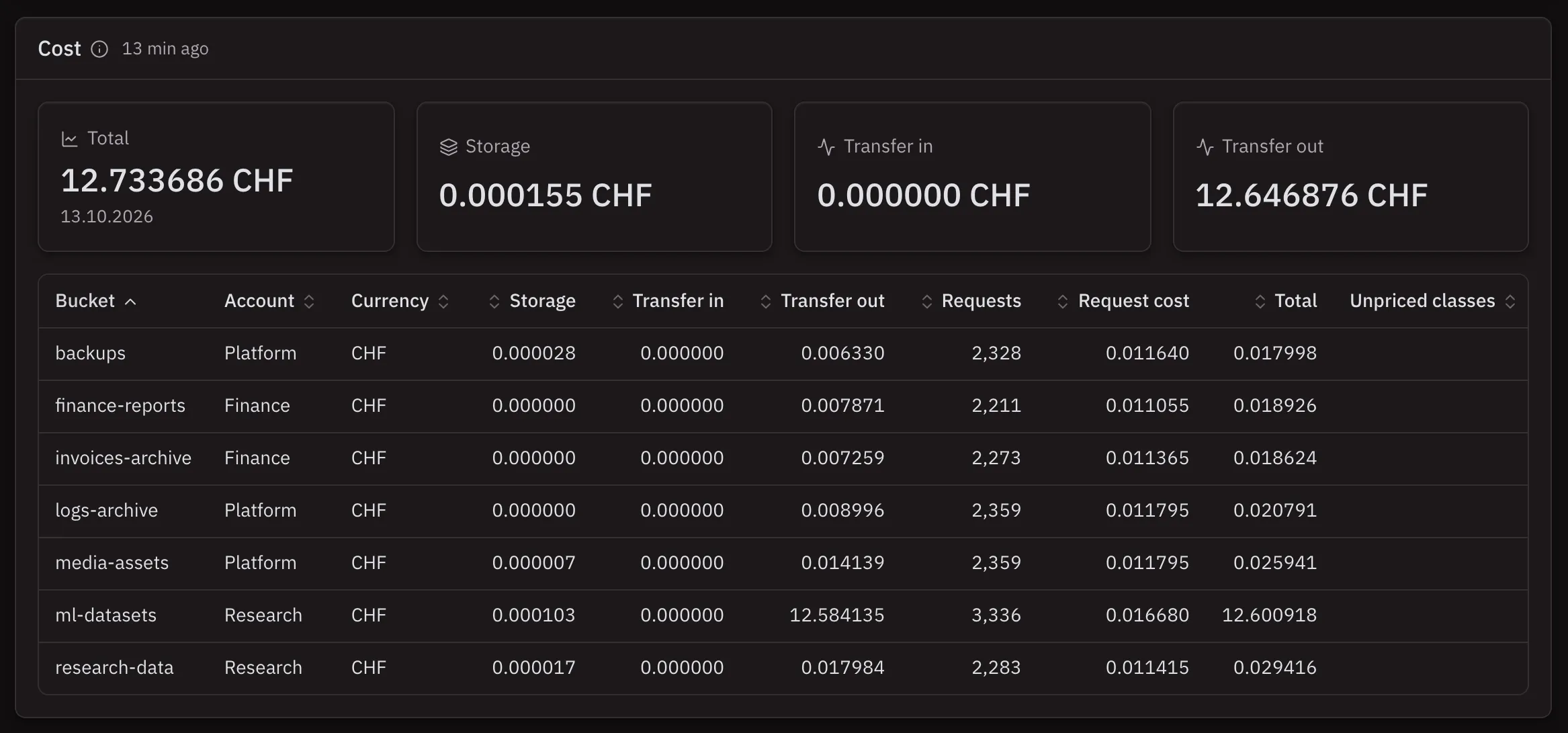
Parallax shows what each bucket costs, how it is used, and where it grows.It recommends lifecycle rules, storage classes, and compression, with the evidence behind each one.
- FinOps: cost, capacity, and growth at a glance
- Find cold data and waste
- You approve every change before it applies
Everything in view
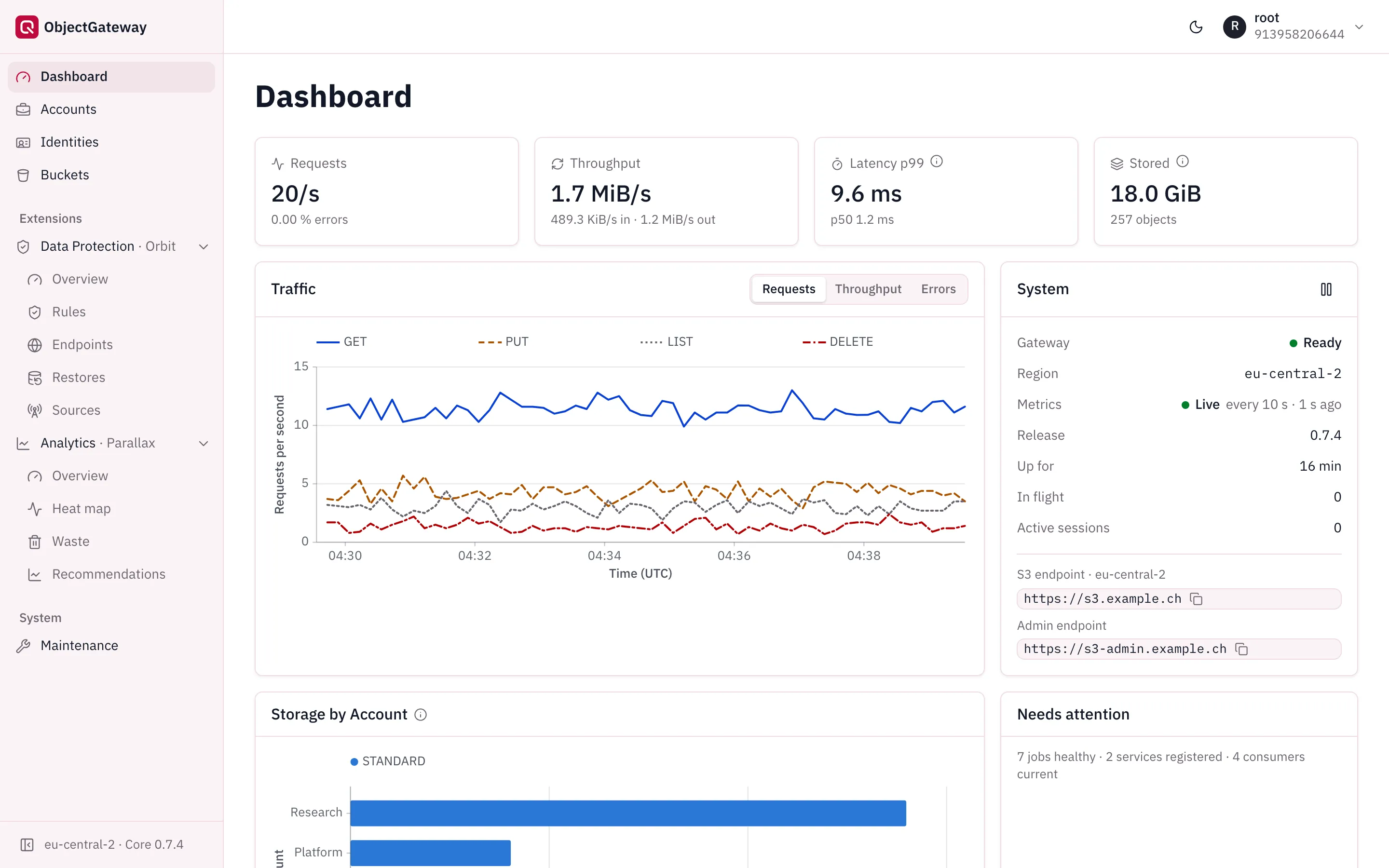
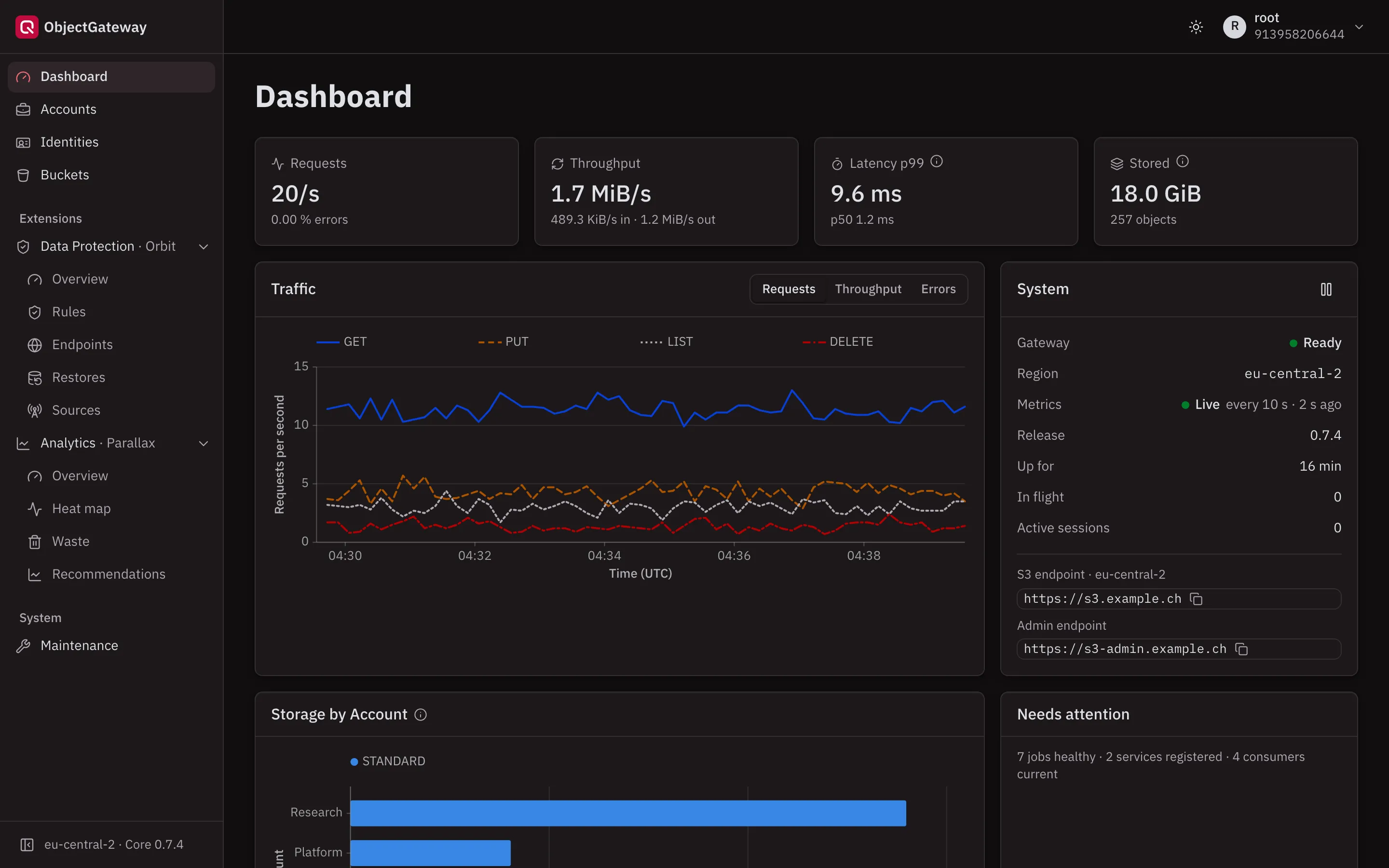
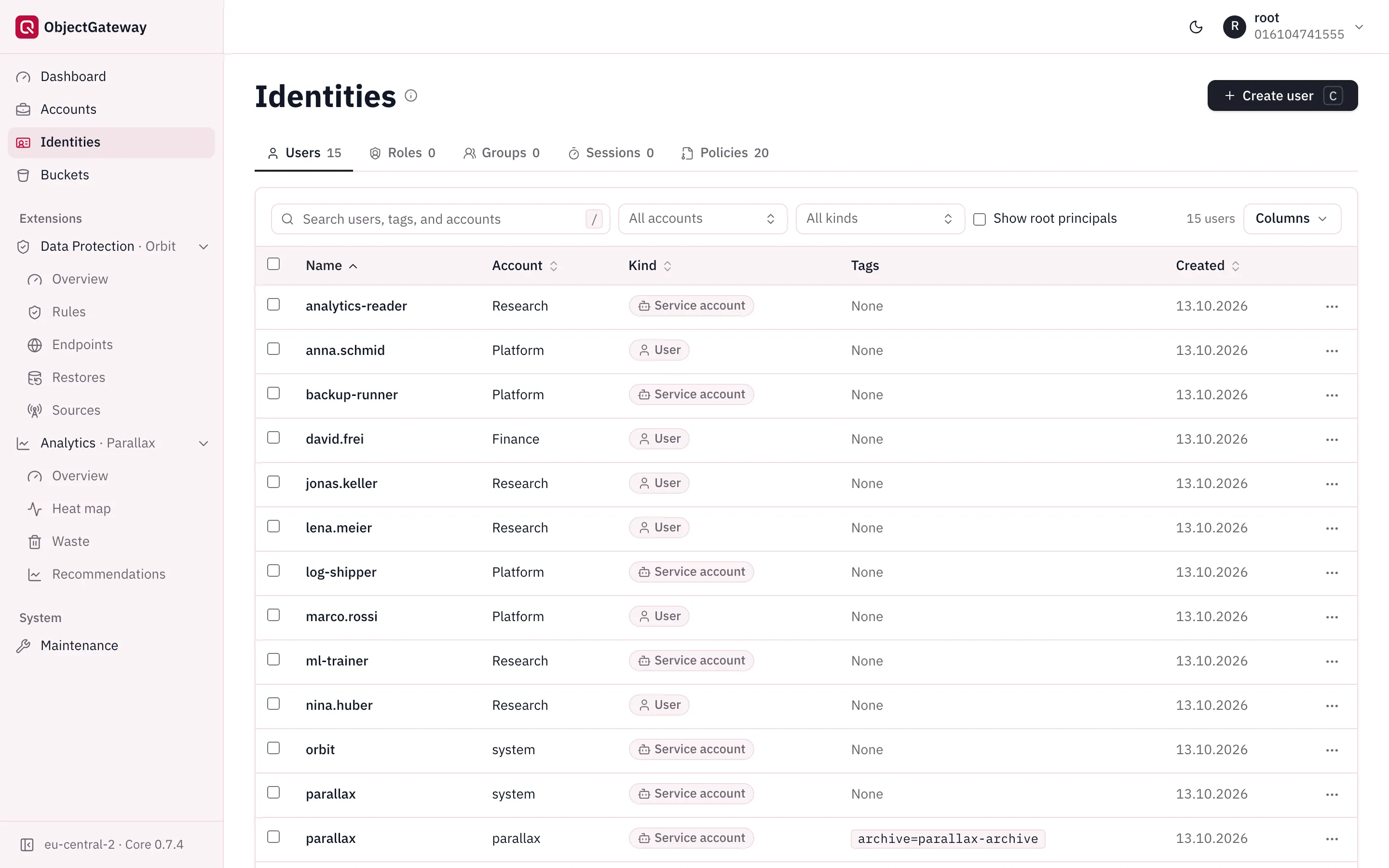
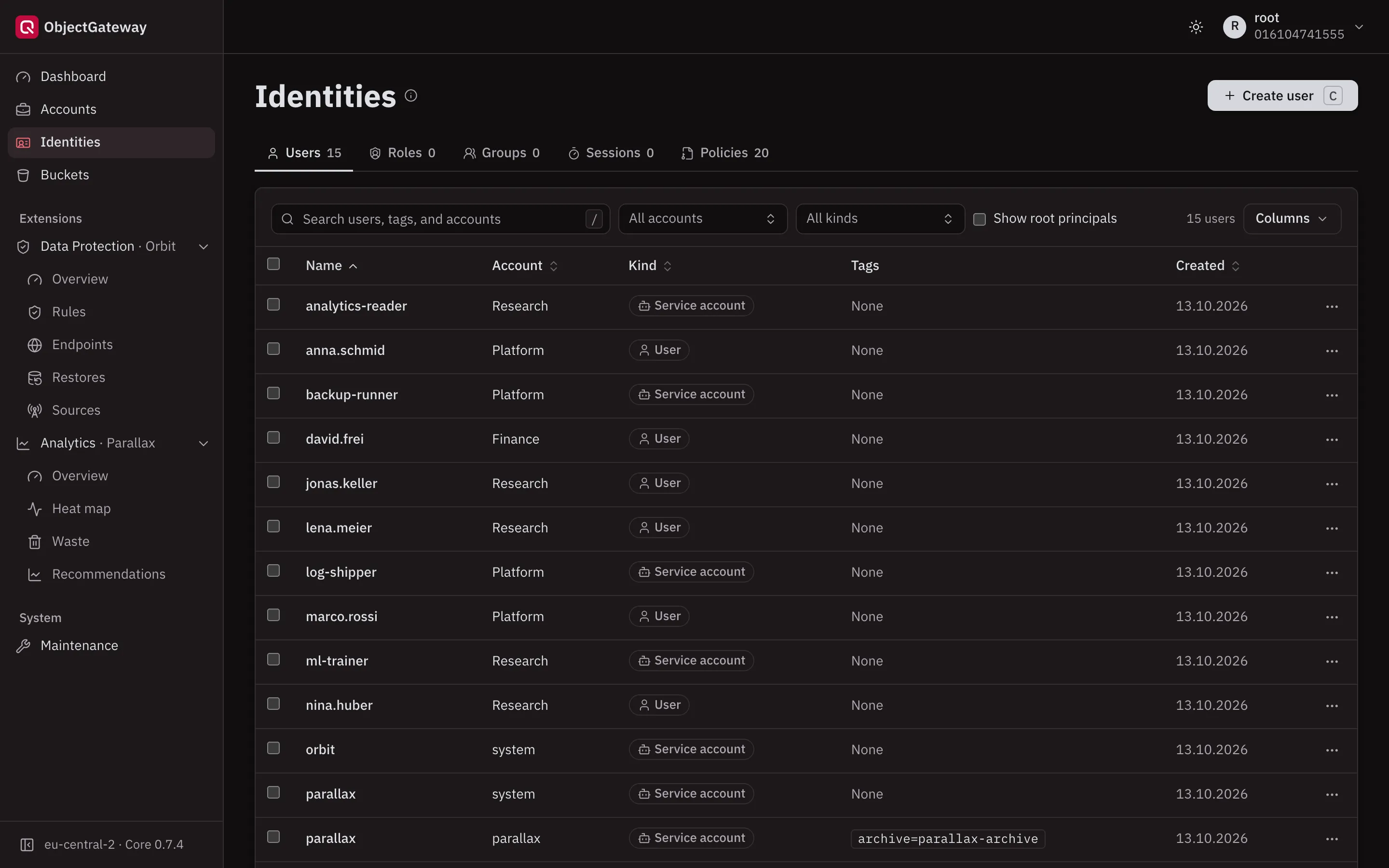
The console shows accounts, identities, buckets, and traffic in one place.Daily work needs no command line.
AI native
Ready for your AI agents and pipelines
Ask in plain language, or automate it yourself.Your agent works with the ogw CLI and its built-in skill, and your own tools use the same Admin API.
- Works with Claude Code and other agents
- Always matches your installed version
- Nothing is deleted without explicit confirmation
- An OpenAPI document for the Admin API in every release
Orbit
Protect your data across sites
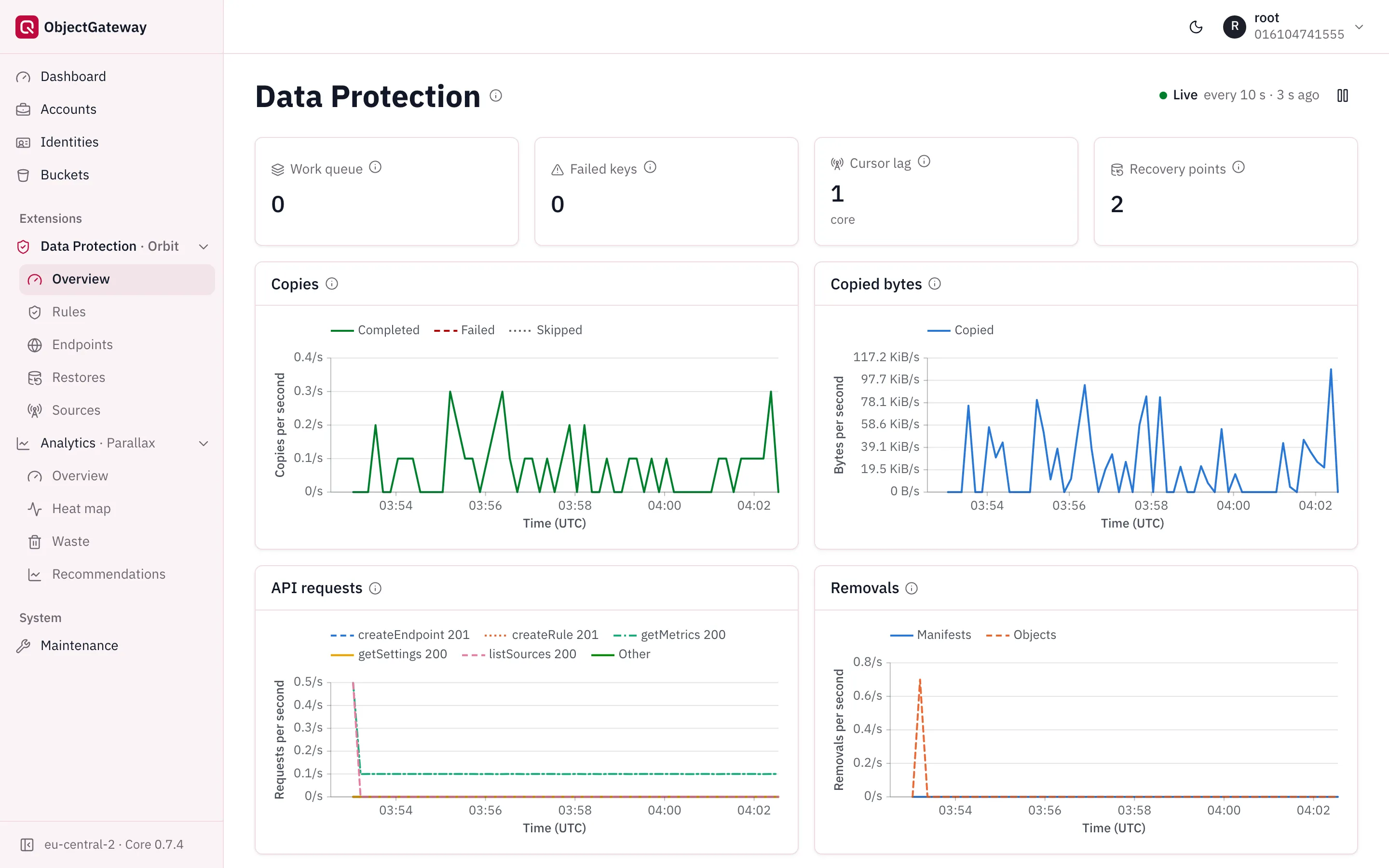
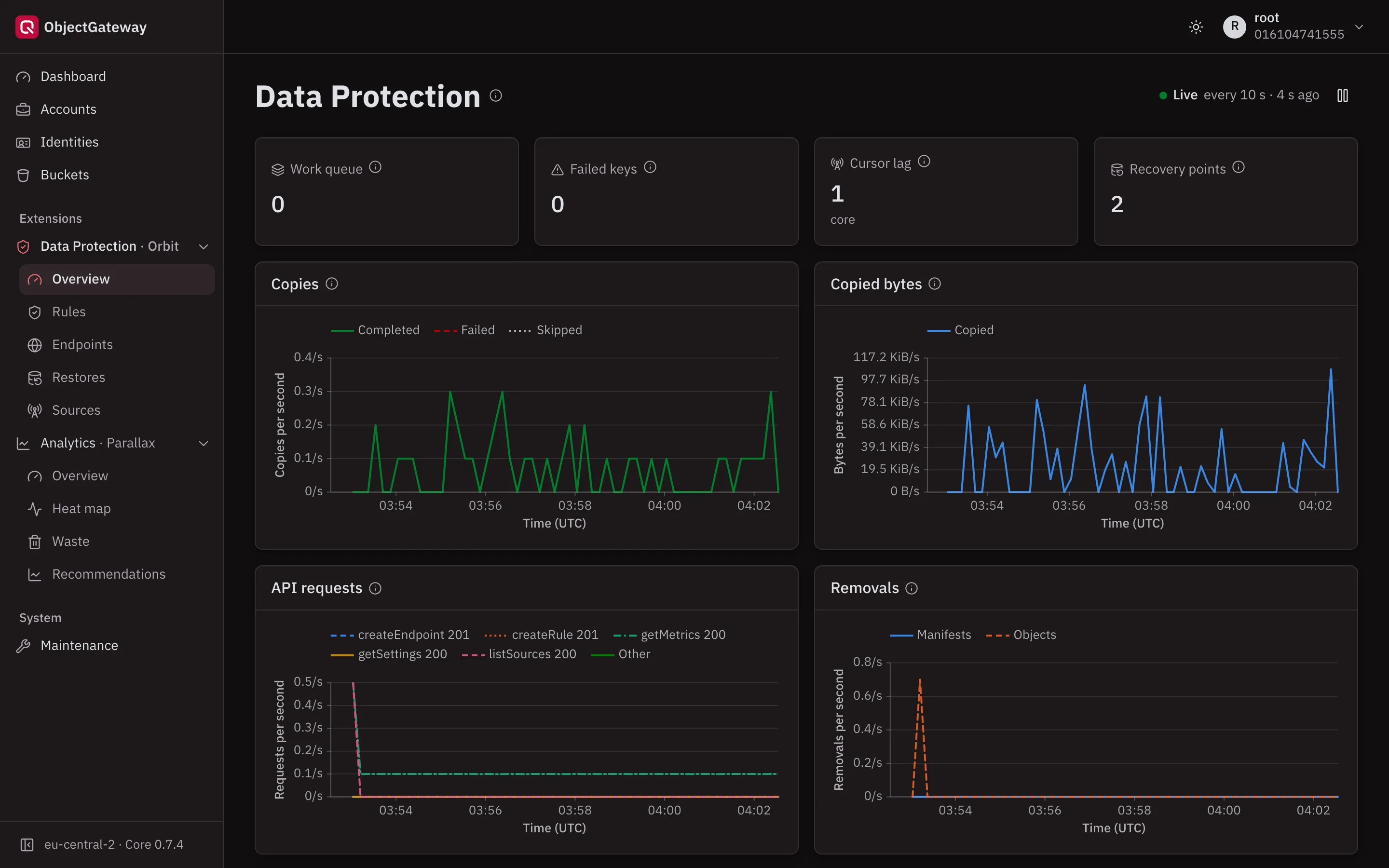
Orbit copies objects between buckets and sites by rules.It also keeps encrypted recovery points of your buckets in any S3 bucket.
- Replicate between sites by rule
- Encrypted recovery points in any S3 bucket
- Restores that you start, follow, and cancel
The S3 your applications need
Built for the S3 features that backup tools, data platforms, and AI pipelines rely on.
- Versioning
- Object lock
- Lifecycle rules
- Storage classes
- Quotas
- Identities and policies
- Single sign-on with OpenID Connect
- Encryption
- Static websites
- Event notifications
- Prometheus and OpenTelemetry
Who ObjectGateway is for
Public sector and regulated industries
Self-hosted S3 with audit trails, your own keys, and a documented exit path. From a Swiss vendor that you can hold to account.
Hosting and service providers
Offer S3 to your customers on the storage that you already run. Separate accounts and quotas per customer are built in.
Small and mid-sized companies
S3 for backups and new applications on the NAS that you already have. No storage cluster to learn and run.
Roadmap
What we are currently working on.
Available now(Current stage)
ObjectGateway
S3 on your POSIX storage
Console and CLI
Administration in the browser, in scripts, and with AI agents
Orbit
Replication and backup
Parallax
Analytics and FinOps
Next
Event Bridge
Bucket events to Kafka, NATS, and RabbitMQ
Houston
Kubernetes operator
Turnkey deployment
The whole stack, ready to run in a few steps
After that
More storage backends
New backends on the storage interface that ObjectGateway already has
Automated recommendations
Parallax applies its recommendations on its own, within the rules that you set
Then
General availability
The first generally available release
Questions and answers
Which storage does it work with?
With POSIX filesystems. We have confirmed:
- Local filesystems such as XFS, ZFS, and ext4
- Network storage such as NFS
Other POSIX filesystems work as well.
Will my S3 applications work with it?
Yes. Every release is tested with:
- the AWS CLI
- the AWS SDKs for Go and Python (Boto3)
- MinIO Client
- s3cmd
- rclone
Where ObjectGateway differs from Amazon S3, the documentation says so.
How is ObjectGateway tested?
Every release passes an end-to-end gate before it ships:
- The real gateway, driven by these clients
- Simulated crashes at the points where data could be lost
- Fuzzing of every parser
- An upgrade test from the previous release
- A stop when performance drops by more than ten percent
How do I run it?
As one process with one data directory, without a database or a cluster.
- On Linux, as a systemd package, with Compose, or with the Helm chart on Kubernetes
- With the console and the ogw CLI
- A Kubernetes operator, Houston, is coming soon
The gateway is small enough for edge sites. At about 1,000 requests per second across one million objects, it uses about 100 MiB of memory.
The gateway itself needs little CPU. Most of the work is the filesystem writing your data safely to disk, so the disks decide the size of the server, not the cores.
The container image holds only the gateway, with no operating system, shell, or package manager inside.
Can I offer S3 to several customers?
Yes. Each customer gets an account of its own, with its own users, keys, policies, and quotas. Customers do not see the buckets of other customers.
Can I move data from another S3 store?
Yes. Every S3 tool that copies between buckets works, for example rclone or the AWS CLI.
Where is my data, and how is it protected?
In your data center, on your storage.
- Every object is on disk before ObjectGateway confirms the write. After a crash, you find either the old or the new version of an object, complete
- Encryption with keys that the gateway holds (SSE-S3) or with your own keys (SSE-C)
- Default encryption for every write to a bucket
- Object lock in governance or compliance mode, and legal holds
In compliance mode, nobody can remove a locked version before its date, not even the administrator.
Can I automate the administration?
Yes. The console and the CLI both work through the Admin API.
- Every release ships an OpenAPI document of every operation
- Generate a client for your own tools and pipelines
- Every call is recorded in the audit trail
Do I need Orbit and Parallax?
No. ObjectGateway runs on its own. Orbit adds replication and backup, and Parallax adds analytics and cost insight, when you need them.
Who is behind ObjectGateway?
Quadrant Systems, a software engineering company in Switzerland. We build software that keeps organizations in control of their infrastructure.
Stay up to date
Get news about ObjectGateway: releases, new features, and articles.Only when there is something worth reading.